Special Report

Printing costs more than digital. The paper copy still wins.

A digital version of the same content costs a fraction of what it costs to print and mail. NRMA's Open Road has run as a printed, quarterly magazine since 1927, and it still reaches more than 1.3 million Australians an issue. In 2025 the company built a digital content hub to sit alongside it. It didn't replace the print run.

That's the actual puzzle. If digital were simply better, cheaper would have won by now. Three separate strands of research point at what a printed copy is doing that a screen can't: touch changes how much people feel something belongs to them, paper measurably changes how well people process what they read, and being physical changes how much people value a thing, independent of what it says.

None of this makes a digital newsletter a mistake. It means the choice between the two is often made on production cost alone, when the research says it's really a choice about attention, memory, and how much value someone assigns to what they've been given.

The story in four parts

A century-old magazine, still mailed

NRMA prints and posts Open Road every quarter, and built a digital hub alongside it rather than instead of it.

Touching an object makes it feel like yours

Peck & Shu (2009): people who touched an object, even briefly, felt more ownership over it, and paid more for it.

The page still beats the screen

Mangen et al. (2013): students who read the same text on paper scored higher on comprehension than students reading it on screen.

The same file, worth less on a screen

Atasoy & Morewedge (2018): identical content was valued and paid for more when it arrived as a physical object.

The evidence at a glance

1.3 million readers, unchanged since 2025

NRMA still mails Open Road to more than 1.3 million Australians an issue, and its 2025 digital hub launched alongside the print run, not instead of it.

Touch alone raises perceived ownership

Across four separate studies, briefly touching an object, or just imagining touching it, made people feel more ownership and pay more for it.

Paper beat screen on a real test

72 tenth-graders scored significantly higher reading the same text on paper than reading an identical PDF on screen.

The same content, priced higher on paper

Across five separate experiments, people paid more for a physical version of identical content than for the digital one.

A magazine that could be sent for almost nothing, and still isn't

The clearest live example of this tension is sitting in Australian letterboxes right now.

Real-world example

NRMA's Open Road magazine (Australia, since 1927)

Why keep printing and posting something that could be sent for almost nothing?

Open Road is NRMA's quarterly member magazine, covering car reviews, road trips, and motoring advice. It has run continuously since 1927, and still reaches more than 1.3 million Australians an issue. NRMA prints and mails it four times a year, a real cost that scales with membership size.

In early 2025, NRMA launched a digital content hub alongside Open Road: a website and app section with daily updates, video, and a trip planner, available at close to zero marginal cost per reader. The quarterly print run kept running anyway, unchanged.

What this shows: an organisation with a genuine, ongoing incentive to cut a real printing and postage bill chose to keep paying it. NRMA hasn't published its own reasoning for that choice. What follows is the behavioural evidence for why a physical copy can outperform a digital one, not a claim about what NRMA itself decided.

NRMA (2025). “NRMA's iconic Open Road magazine goes online with new content hub.” Press release. See also: Mi3 and B&T.
Spotted in the wild

The claim above holds up outside NRMA's own press release. A physical copy of the Spring 2026 issue turned up in a real letterbox, and the digital hub launched alongside it is a real, working app tab today.

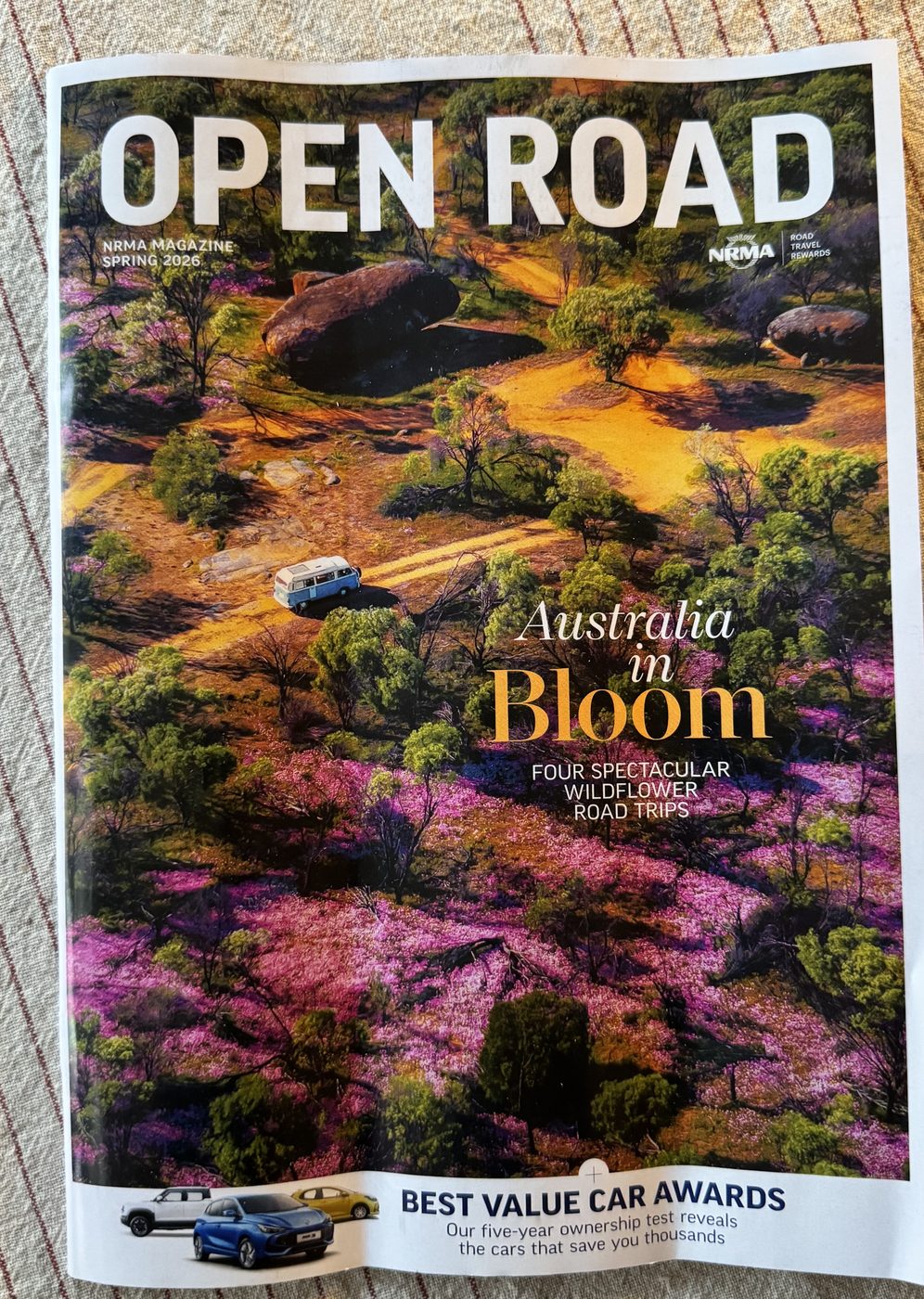
Cover of NRMA's Open Road magazine, Spring 2026 issue, showing the cover story Australia in Bloom: Four Spectacular Wildflower Road Trips and a Best Value Car Awards sidebar.

NRMA, Open Road magazine, Spring 2026 issue: cover story “Australia in Bloom: Four Spectacular Wildflower Road Trips,” plus a “Best Value Car Awards” sidebar. Photographed August 2026.
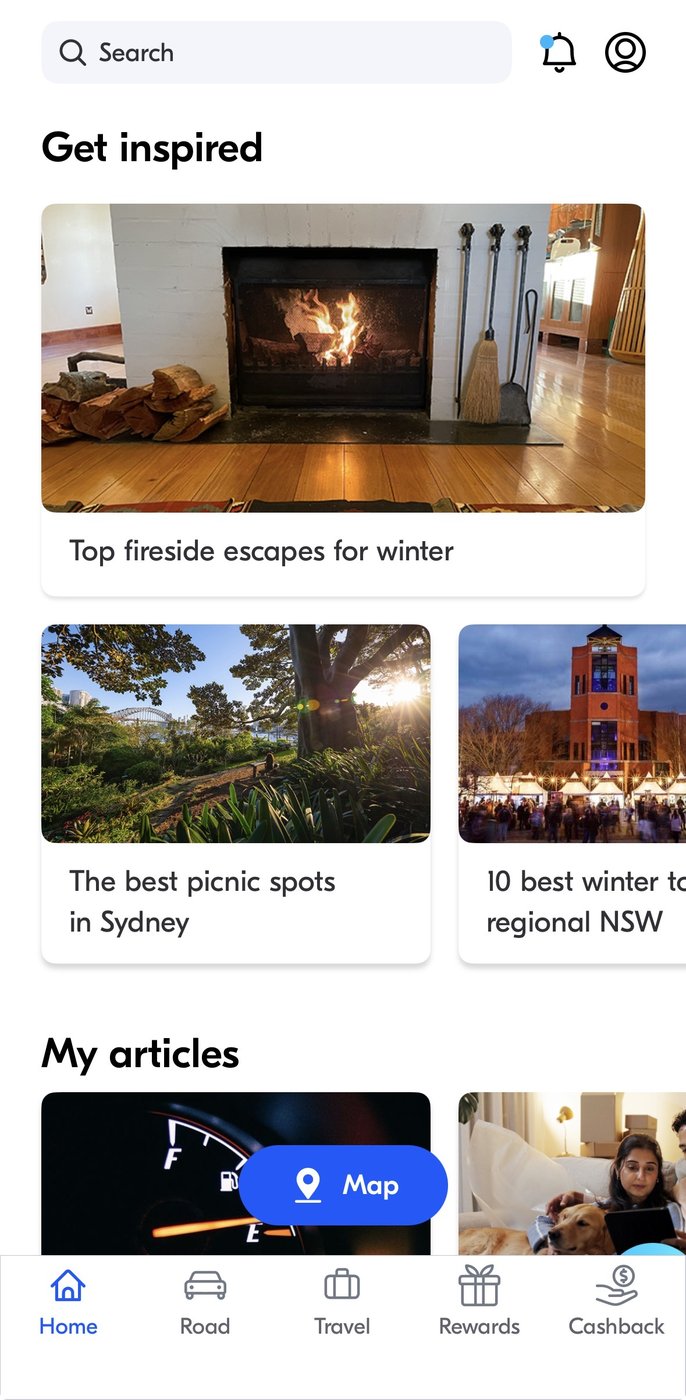
NRMA app home screen showing the Get inspired article feed and My articles reading list, the digital content hub NRMA launched alongside Open Road.

NRMA app, home tab: the “Get inspired” article feed and “My articles” reading list, the digital content hub referenced above. Captured August 2026.

A dated copy on paper and a live screen of the digital hub confirm both formats are still running side by side, well over a year after NRMA's 2025 launch announcement. Neither one measures whether the print edition works better than the digital one. That's what the cited studies above, and the linked experiment below, actually test.

Touch creates a claim of ownership

This site's Endowment Effect entry covers what happens once someone already owns something: they value it more than they would if they were buying it fresh. Joann Peck and Suzanne Shu's research asks an earlier question: how little contact does it take to trigger that same feeling, before any actual ownership exists?

Peck, J., & Shu, S. B. (2009). “The Effect of Mere Touch on Perceived Ownership.” Journal of Consumer Research, 36(3), 434–447
Four separate studies on how physically touching an object changes how much a person feels it already belongs to them.
ParaphrasedAcross four studies, participants who briefly touched an object, or were only told to imagine touching it, reported higher perceived ownership of that object than participants who just looked at it.
ParaphrasedTouch also raised how much people were willing to pay for the object, and the effect held for people acting as sellers as well as people considering a purchase.
ParaphrasedThe authors tie the finding to a real 2003 warning from the Illinois attorney general's office, cautioning holiday shoppers that some retailers deliberately encourage handling merchandise to increase the urge to buy it.

The page does something the screen doesn't

A magazine that gets picked up, flipped through, and put down again isn't just triggering touch. It's also being read on paper rather than a screen, and that swap changes comprehension on its own.

Mangen, A., Walgermo, B. R., & Brønnick, K. (2013). “Reading Linear Texts on Paper versus Computer Screen: Effects on Reading Comprehension.” International Journal of Educational Research, 58, 61–68
72 Norwegian tenth-graders read the same two texts, split between a printed copy and an identical PDF on a computer screen.
ParaphrasedStudents who read the texts on paper scored significantly better on the comprehension test than students who read the identical material as a PDF on screen.
ParaphrasedThe authors suggest print offers physical, spatial cues, where a page sits, how thick the read-so-far and remaining sections are, that a scrolling digital document doesn't reproduce, and that losing those cues may make it harder to build a mental map of a longer text.
Also worth citing: a 2015 neuroscience study commissioned by Canada Post used EEG and eye-tracking on 270 participants and found direct mail took 21% less mental effort to process than an equivalent digital ad, and produced roughly 70% higher unprompted brand recall. Canada Post sells mail for a living, so treat those specific numbers as industry research, not peer-reviewed evidence. The direction matches what Mangen's study found under much more controlled, independent conditions.

The same file, worth less on a screen

The furthest-reaching of the three findings doesn't need touch or reading at all. It's about what happens to the value of identical content once it stops being a physical object.

Atasoy, O., & Morewedge, C. K. (2018). “Digital Goods Are Valued Less Than Physical Goods.” Journal of Consumer Research, 44(6), 1343–1357
Five experiments comparing what people will pay for a physical object against an otherwise identical digital version of the same content, including souvenir photographs, books, and films.
ParaphrasedAcross all five experiments, participants consistently valued, and were willing to pay more for, physical versions of a good over digital versions carrying the identical content.
ParaphrasedThe gap was explained by psychological ownership: physical goods generated a stronger sense that an object was “mine” than digital goods did, and that difference in felt ownership, not the format itself, accounted for the valuation gap.

None of these three studies tested a real, recurring member magazine. Peck and Shu tested touch on everyday consumer objects. Mangen tested school reading comprehension. Atasoy and Morewedge tested valuation of digital vs. physical photos, books, and films. This report combines three separate, real findings to explain why a physical copy might outperform a digital one for something like Open Road. Whether it actually does is the open, testable question, and it's exactly what the linked experiment below proposes to test.

What this means for acquisition and retention

The three studies above explain why a printed magazine gets touched, read, and kept. A newer study, from two of the same researchers behind the touch-and-ownership finding, tests what that translates to commercially: whether a stronger feeling of ownership over something tangible actually changes whether a customer stays.

Yoon, Y. R., Peck, J., & Shu, S. B. (2025). “Increasing Hotel Loyalty Through Psychological Ownership.” Cornell Hospitality Quarterly, 66(3), 277–293
An analysis of 14,689 TripAdvisor reviews, a field experiment in a working hotel (n=82), and two controlled lab studies (combined n=1,002).
ParaphrasedAcross all three methods, guests who felt greater psychological ownership of their hotel room were more loyal to the hotel, and the effect held even after controlling for how satisfied they were with the stay itself.
ParaphrasedThe authors point to letting guests customise a tangible part of the room, choosing a pillow type or the lighting at check-in, as a low-cost way to build that same feeling of ownership.

Open Road is a tangible object a member can hold, not a service outcome they rate. If this mechanism generalises past hotel rooms, mailing a physical magazine four times a year is a recurring, low-cost touchpoint that reinforces felt ownership independent of whatever a member thinks of their last roadside call-out. That's a loyalty lever satisfaction scores alone would miss entirely.

The acquisition side of this argument is less directly tested. Peck and Shu's willingness-to-pay finding and Atasoy and Morewedge's valuation gap both point the same way: a physical welcome pack or membership card should make a stronger first impression, and support a higher perceived value, than a digital-only equivalent. None of the three studies on this page tested that moment of signup itself, so treat this as a reasoned extension of proven mechanisms, not a fourth verified finding.

Three questions worth asking before going digital-only

  1. Is this something a person keeps around, or reads once and discards?The valuation gap Atasoy and Morewedge found is about objects people hold onto. A one-time transactional notice has less to gain from a physical version than something meant to sit on a shelf or a coffee table.
  2. Would the physical version actually get touched, not just posted and binned?Peck and Shu's effect depends on contact happening. A printed piece that goes straight into recycling unopened gets none of the ownership benefit it would otherwise carry.
  3. Is the case for going digital-only being made on production cost alone?Digital is reliably cheaper to produce and send. That's a real, legitimate factor. It isn't the only one the research says matters.