How do you trust a shirt you've never tried on, the first time and every time after?
Proper Cloth, founded in New York in 2008, sells made-to-measure shirts online. Son of a Tailor, founded in Copenhagen in 2014, sells made-to-order t-shirts the same way. The shared pitch is a garment cut for one body, bought from a company that has never seen that body in person.
A first order hits five practical questions in a fixed order: sizing from sparse data, what happens when that size is wrong, whether production labour stays hidden, how much the buyer designs before paying, and why a stranger would trust the process before any cloth is cut.
On sizing, design, and first-buyer trust the two brands land in almost the same place. Remakes versus named labour is where they diverge, and that split is the useful part of the comparison. A later section covers how those five questions change once the customer already owns a shirt.
Tech & Product Design
What Feels Premium
Take-the-Best Heuristic
Online clothing still starts with a sizing problem: predicting fit without a fitting room. Proper Cloth's Smart Sizes quiz covers height, weight, body shape, and preferred shirt drape, then scores those answers against tens of thousands of earlier customers' measured profiles. From that, it forecasts 16 fit points (collar, chest, sleeve, and the rest) with no tape measure in the buyer's hands. Son of a Tailor asks even less. Its Ideal Size model uses five multiple-choice items (height, weight, age, jeans size, shoe size) and the same kind of outcome-trained regression. Son of a Tailor reports above 95% accuracy across more than 100,000 orders. That figure is the company's own marketing claim, not an independent study, so treat it as unverified until someone else repeats it. The behavioural finding does not need either percentage to be exact. Take-the-Best Heuristic is the pattern: a short list of cues that actually predict the outcome can match a longer self-report. Sixteen database-backed fit points usually beat a first-time buyer's home measurement. Five numbers people already know tend to do the same job.
Loss Aversion
Any statistical fit still fails for some bodies, and here the brands take opposite routes. Proper Cloth diagnoses the miss and cuts a replacement size at no extra charge. The sizing screen states that up front as free 60-day returns and remakes, before Add to Bag. Shirts from about $125 are made for one body; there is no rack size to swap into if the first cut is wrong, so the purchase carries a concrete downside before production starts. Under Loss Aversion, that downside weighs more than the upside of a good fit. Promising a remade shirt (rather than only a refund) is what lowers the barrier enough for many browsers to order.
Operational Transparency
Proper Cloth repairs a bad guess after the shirt exists. Son of a Tailor spends its energy making factory work visible before anything goes wrong. Every order gets its own generated pattern and is sewn end to end by one named person who signs the hangtag. Status updates in the account and by email mark each production stage, instead of a single “shipped” note at the end. A mass-market tee usually moves through anonymous hands on a line the buyer never sees. The site labels that contrast Operational Transparency: showing labour that would otherwise stay hidden raises how much people value the finished piece. An open kitchen does the same job for a plate; here the signature and the progress emails do it for cloth.
IKEA Effect
Remakes and signed hangtags only matter after someone has already ordered. The design step usually decides whether that order happens. Proper Cloth's configurator walks through hundreds of fabrics, more than 30 collar options, plus cuffs, plackets, and monograms, and can save the mix as a Style Profile. Son of a Tailor is lighter: colour, neckline, sleeve, pocket, and initials come before the sizing questions. Neither tool is a one-tap preset bundle; each asks for real choices. IKEA Effect is the finding that labour put into making something raises how much the maker values it. A 2020 customisation-tool study reported the same pattern: more genuine design choice predicts higher valuation of the finished item. A shirt the buyer configured feels more theirs than an off-the-rack pick, even when fabric quality is held constant.
Social Proof
Sizing, remakes, labour visibility, and design labour still leave a first buyer cold if they will not try the process. They are paying for cloth that does not exist yet, cut from a model of a body the company has never met. Proper Cloth sits at 4.9 out of 5 on Trustpilot across several hundred reviews, with repeated notes that free remakes were actually honoured. Earlier in the flow, the fit picker labels Slim as “Most Popular,” steering a new customer toward the option other buyers already chose. Son of a Tailor sits around 4.6 to 4.7 across more than 2,700 reviews, and many of those reviews single out the sewer's signature as part of why the wait felt justified. Social Proof converts those public tracks into permission. Other strangers vouch for the two risks that matter here: that the size lands close enough, and that the company treats the process (and the person sewing it) seriously. Aggregate ratings do not prove the algorithm works for any one body. They only show that enough people already ran the experiment and stayed glad they did, which is how the opening trust problem gets solved in practice.
What changes on the second order
The five stops above describe a stranger ordering before any shirt of theirs exists. A return customer still meets the same mechanisms, but the weights shift.
Take-the-Best Heuristic and Operational Transparency barely move. The saved Smart Sizes or Ideal Size profile is the earlier prediction reused. Production is still tracked per order, and Son of a Tailor still attaches a named sewer's signature.
Loss Aversion now guards a different comparison. First orders worry whether an unseen body can be guessed at all. Repeat orders worry whether a new fabric or style will match a shirt that already worked. The free remake still covers a miss, but the reference point is now the customer's own previous fit rather than a blank slate.
IKEA Effect only fires when there is a new design choice to make. Reordering the identical shirt skips that labour, so it does not earn the extra attachment a fresh colour or collar would. Social Proof matters least of all on a return visit. The first order needed strangers' reviews; the second already has stronger evidence: a shirt that arrived and fitted. That garment becomes the benchmark the next order is judged against.
Spotted in the wild
One real Proper Cloth purchase path: fit choice, checkout, complimentary remake, then the saved size profile that followed.
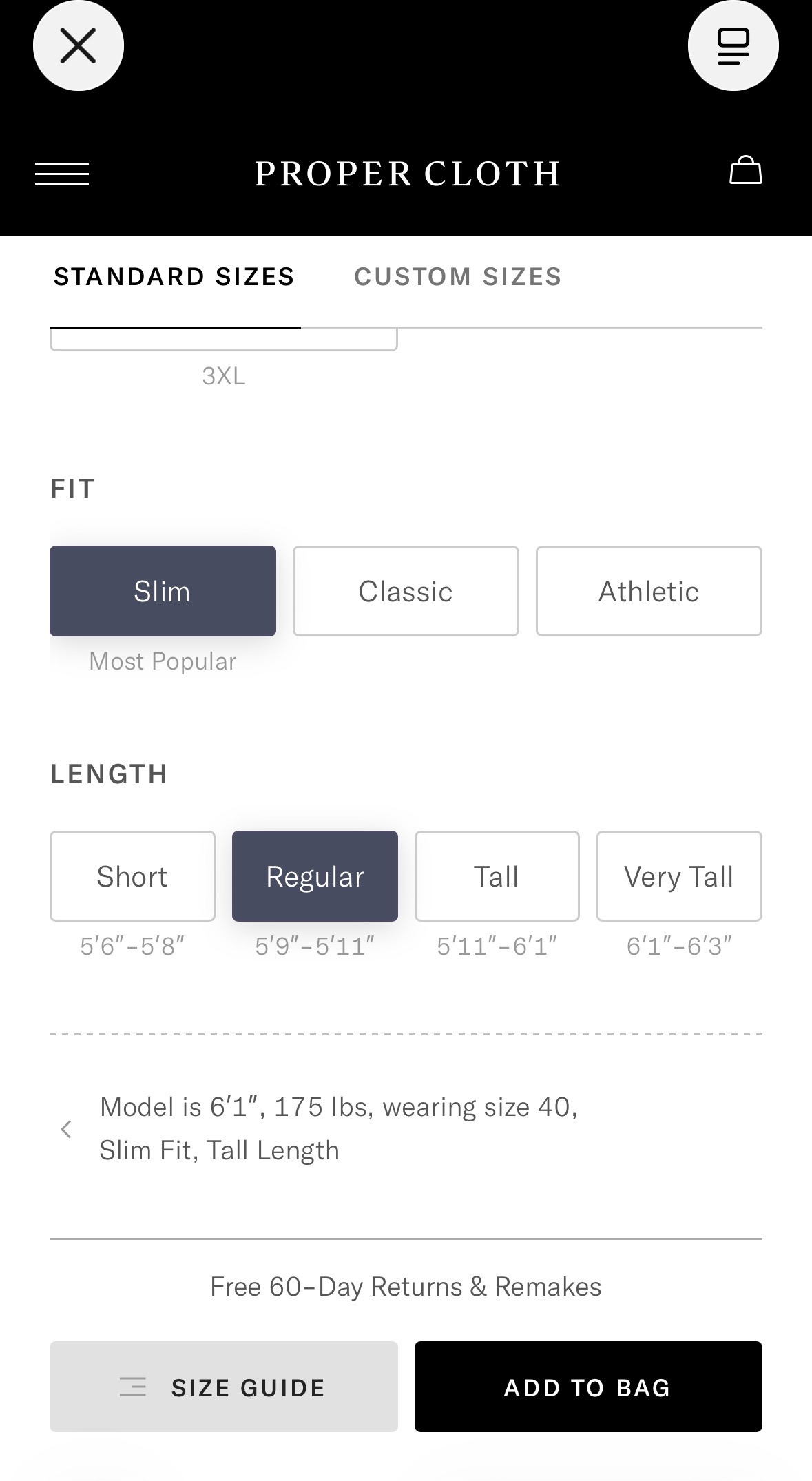
Sizing screen before commitment: Slim tagged “Most Popular,” with “Free 60-Day Returns & Remakes” sitting above Add to Bag. Social Proof and Loss Aversion are both on that one screen.
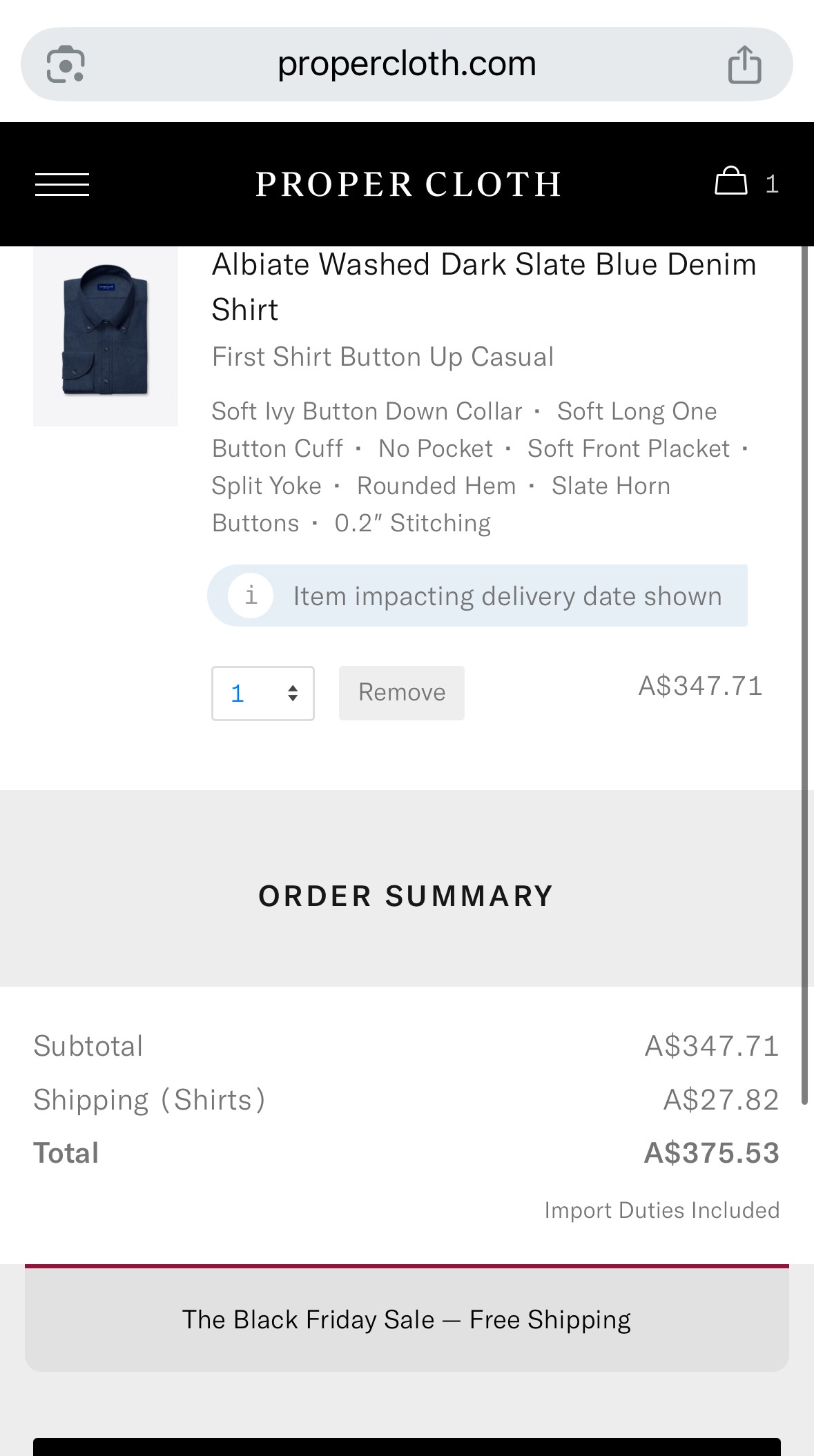
Checkout for an Albiate washed dark slate blue denim shirt from the Smart Sizes path, A$375.53 including shipping.
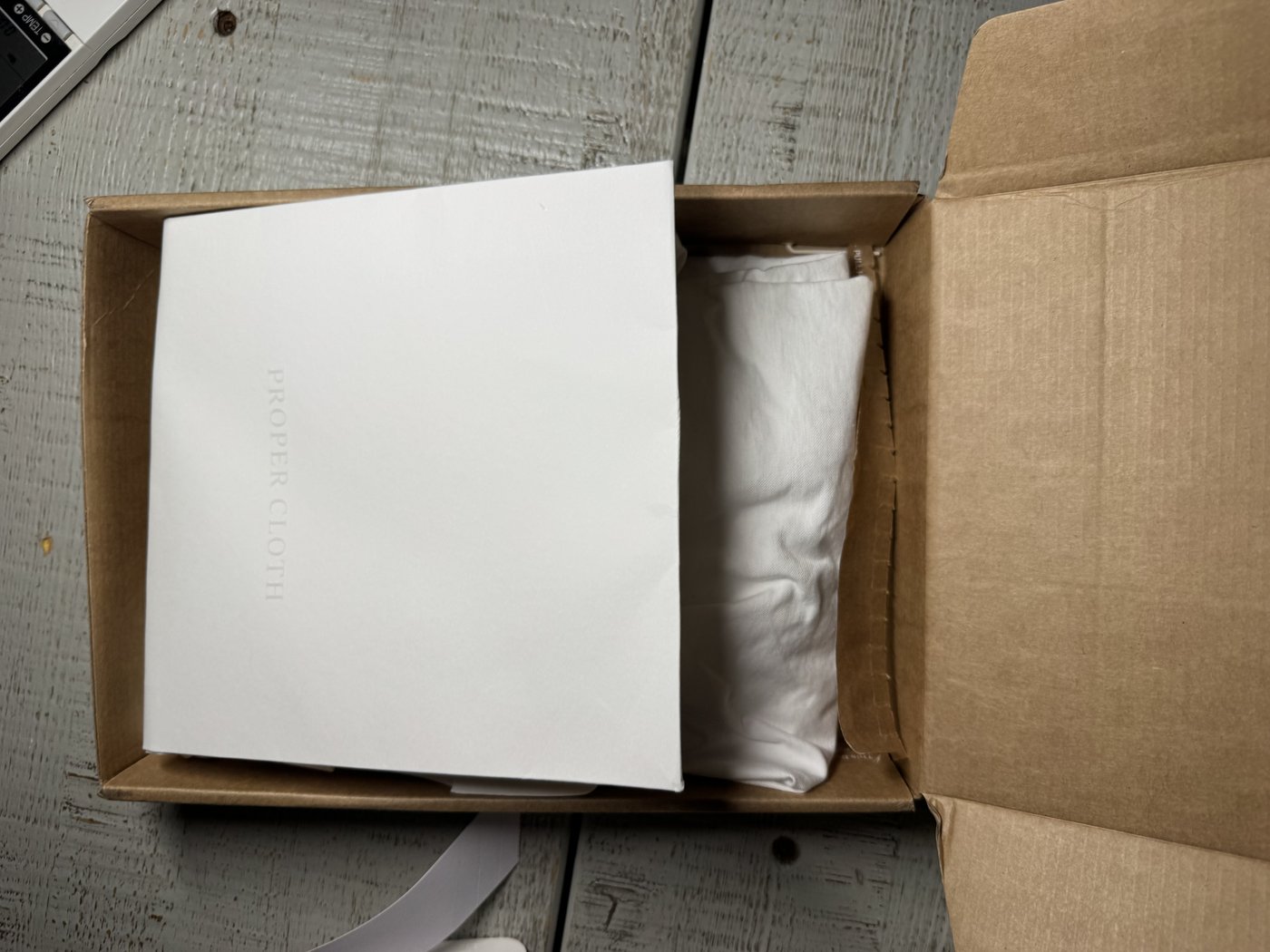
Arrival: the shirt inside Proper Cloth's recyclable kraft-paper packaging.
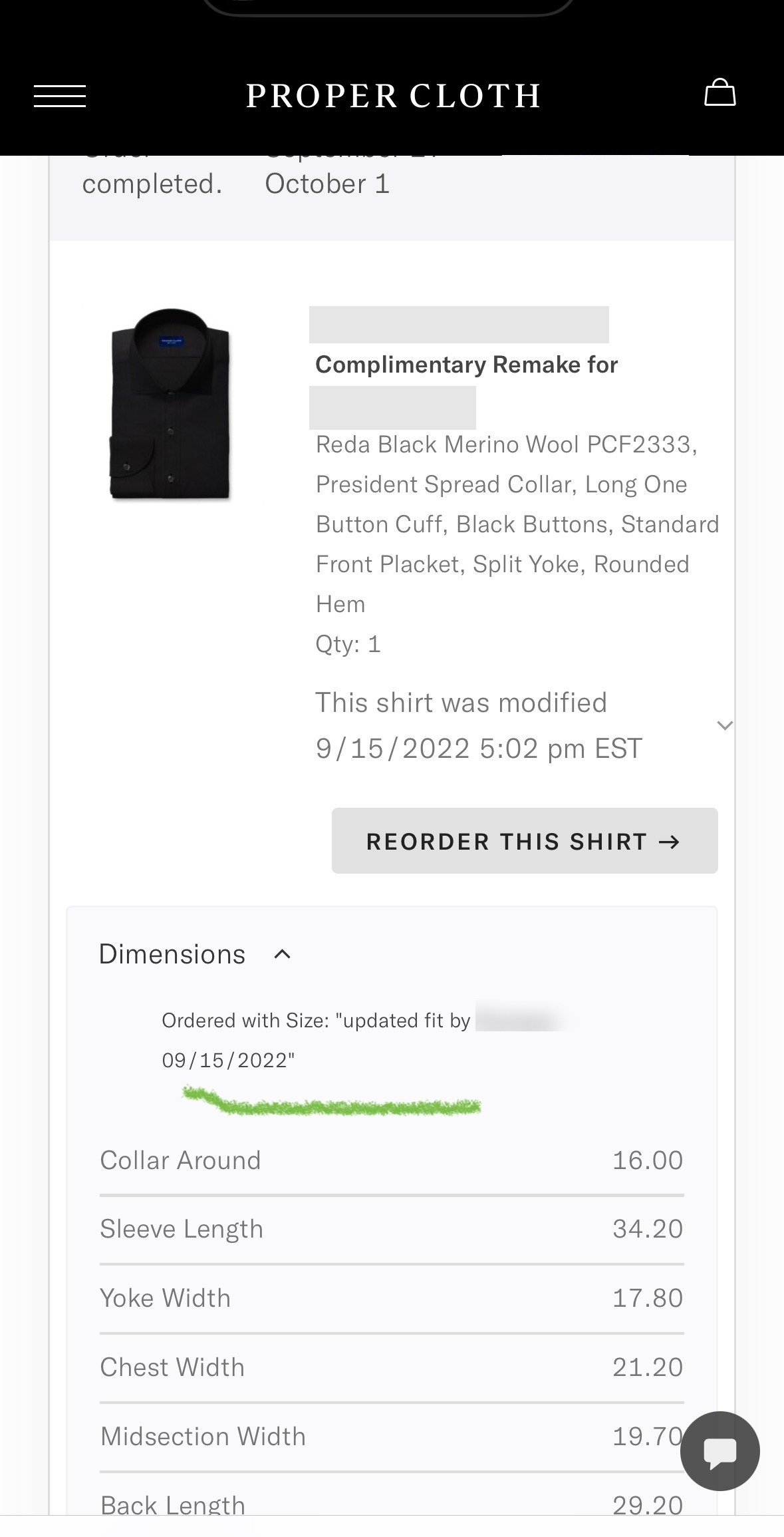
The remake policy in use: an order labelled “Complimentary Remake” after the first shirt's size was adjusted. The staff member's name is blurred for privacy.
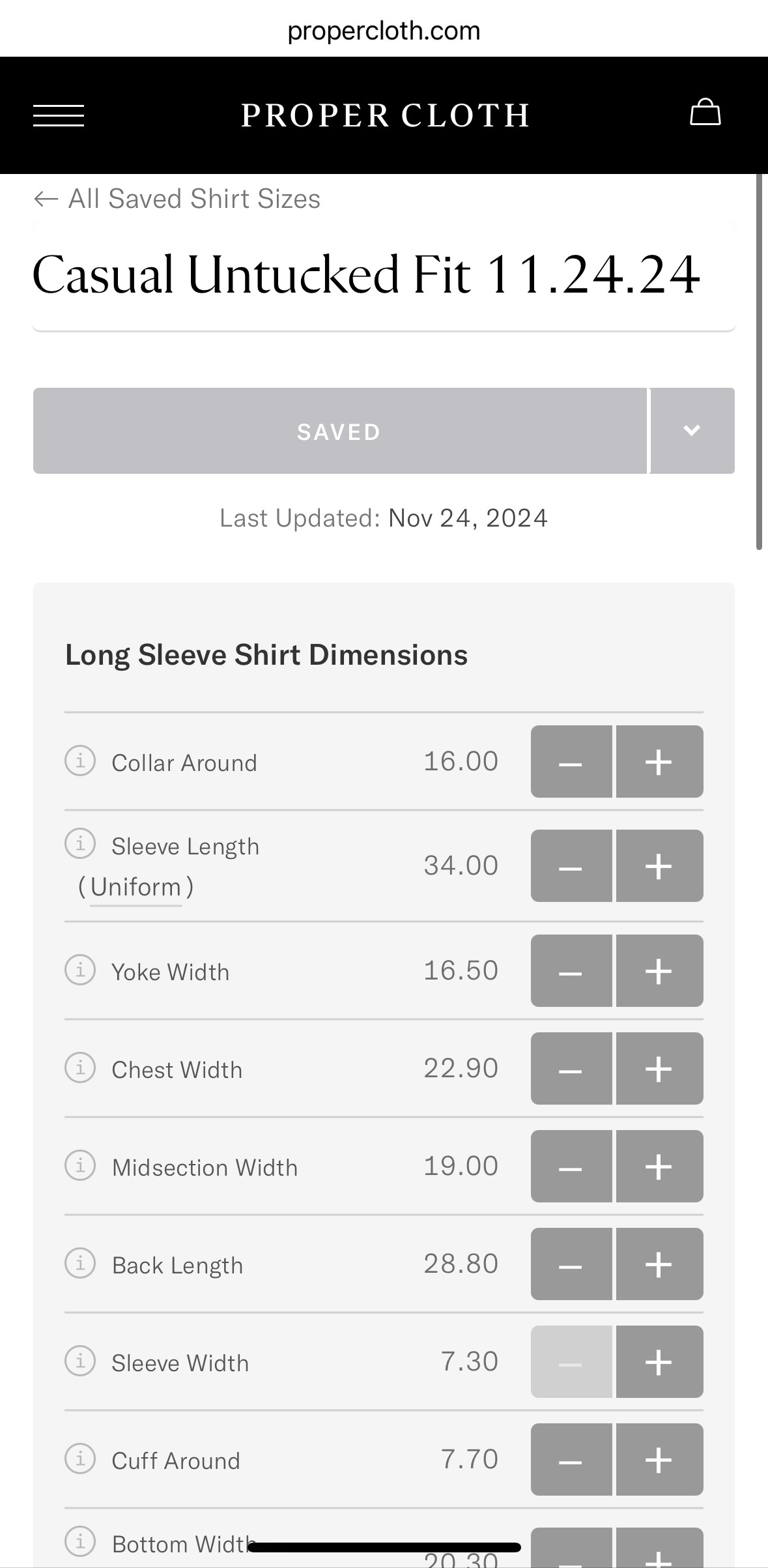
Months later, the same customer's saved Smart Sizes profile: collar, sleeve, chest, and back length the algorithm is working from.
One customer's order and remake. It does not prove every fit lands first time, or that every order gets a remake. The “Most Popular” tag is Proper Cloth's own claim. Read the live policy on Proper Cloth's site rather than treating these terms as permanent.
Real vs. perceived
Genuinely real
- Both quizzes forecast real fit points from past outcome data (16 for Proper Cloth; a full generated pattern for Son of a Tailor) without a customer tape measure
- A mis-fitting Proper Cloth shirt is remade in a new size at no charge rather than only refunded
- Each Son of a Tailor piece is cut from its own generated pattern, sewn by one named person who signs the hangtag, and tracked through production by account and email updates
- Both design tools offer real fabric, colour, collar, and detail combinations chosen before or alongside fit, rather than a label on a few presets
- Trustpilot ratings and review counts are third-party figures, not authored by either brand
Psychological framing
- Take-the-Best Heuristic: a short quiz can feel like a close reading of one body when the model mostly reuses patterns from thousands of similar answers
- Loss Aversion: a free remake reads as pure service goodwill while also removing the specific fear of paying for a shirt that cannot go back on a rack
- Operational Transparency: a signed hangtag can feel like special attention to this order when the same signed step is standard on every garment
- IKEA Effect: designing the shirt can feel like the main driver of quality when fit and cloth still come from the algorithm and the mill
- Social Proof: a high star average can read as proof this page's mechanisms work when it averages shipping, service, and many other factors into one score
Sources
Take-the-Best Heuristic, Loss Aversion, Operational Transparency, IKEA Effect, and Social Proof each carry their academic citations on the linked Principles entries, including the 2020 customisation-tool extension of IKEA Effect. Proper Cloth's quiz, fit-point count, fabric and collar range, and remake terms come from Proper Cloth's Smart Sizes page, its design tool, and its published FAQs. Son of a Tailor's quiz, algorithm claims, design tool, and production process come from its FAQ and About Us pages. The above-95% accuracy line is Son of a Tailor's own claim, not an independent study. Trustpilot figures were whatever the site showed while this page was researched and change continuously; check Trustpilot for current numbers. Features and prices move too; use each company's site for what applies now. “What changes on the second order” reapplies the same five cited mechanisms to a repeat purchase. Neither brand has published returning-customer data for that section, so read it as reasoning from the cited studies rather than a separately sourced finding.
Real examples
-
Proper Cloth
Decoded above: Smart Sizes quiz, 16 fit points, free remake when the first cut misses
propercloth.com
-
Son of a Tailor
Also decoded above: five-question Ideal Size model, one named sewer per garment
sonofatailor.com
-
Indochino
Made-to-measure suits and shirts via an online measurement quiz, with in-person appointments in some cities
indochino.com
-
MTailor
Replaces the questionnaire with a 360-degree phone video; computer vision estimates roughly 60 measurements
mtailor.com
Operating providers listed to show the same pattern elsewhere. None is an endorsement. Features and pricing shift; use each provider's own site for what applies today.